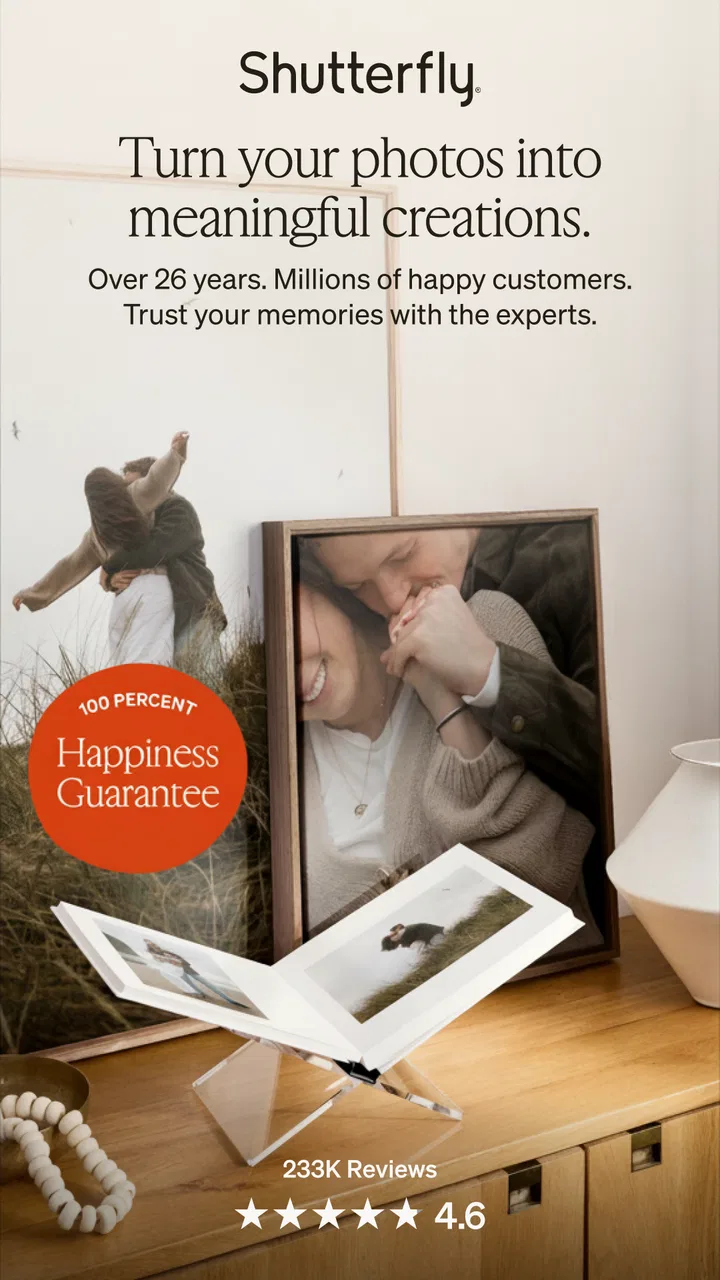
Shutterfly: Prints Cards Gifts
- 4.6
- Rating
- 10.00M
- Installs
- Free
- Price

 Analysis by App-foxy
I first approached Shutterfly: Prints Cards Gifts as a photography app, but its real purpose becomes clear quickly: it turns pictures already sitting on your phone into physical products. That distinction matters. This is not mainly an editing tool for improving a photo before sharing it online. It is a bridge between a camera roll and printed memories, greeting cards, photo books, and personalized gifts.
In my experience, the first session is appealing because the idea is easy to understand. Pick a picture, choose a product, arrange the images, and move toward something tangible. The app is free to install, and Shutterfly, Inc has built it for an Everyone audience, so it feels suitable for family photos, school moments, celebrations, and ordinary snapshots that would otherwise remain forgotten in cloud storage.
The important question, though, is not whether the app can create a nice item once. Plenty of photo services can do that. The better question is whether it deserves a regular place on your phone after the excitement of making one personalized product wears off. My answer is cautiously positive, especially for people who already enjoy giving printed photos or sending custom cards, but I would not call it an essential photography app for everyone.
You May Also Like

 Google Keep - Notes and lists
Google Keep’s Quiet Growth Shows the Appeal of Simpler Notes
As mobile work gets busier, Google Keep keeps winning a simple contest: capture a thought quickly, find it later, and get on with the day.

 Blood Strike: 2.5 Anniversary
Blood Strike’s Loadouts Turn Every Drop Into a Tactical Gamble
A close look at Blood Strike’s custom loadouts: how fast access to signature weapons reshapes its battle royale rhythm, rewards preparation, and narrows the gap between fights.

 Pandora - Music & Podcasts
Pandora’s Music Is Easy to Start, but Harder to Recover
Pandora’s strength is its low-effort path from a seed to a station. Its weak spot is how much confidence it asks you to place in connection, setup, and quiet recovery.

 8 Ball Pool
 Is Built on Rivalries, Rematches, and Routine
A close look at the rivalries, rematches, shared routines, and unanswered safety questions that turn a quick pool match into a persistent mobile community.

 Samsung Music
’s Quiet Strength Is Playing What You Already Own
Its reach comes less from spectacle than from dependable access to a personal library. That simplicity is both the app’s strongest retention engine and its ceiling.

 AccuWeather: Weather Radar
AccuWeather Review: A Quick, Clear Forecast for Everyday Decisions
For everyday plans, the best forecast is the one you can understand quickly. AccuWeather makes rain timing, radar, and local conditions easy to act on, with a few trade-offs.
More From Our News Desk



From an exciting first project to a repeatable photo habit
I find the first project most useful when I treat it as a small, clearly defined task: choose one occasion, gather a short list of photos, and decide what I want the finished piece to say. That approach makes it easier to move from browsing to creating without getting lost in the camera roll. Once that rhythm feels comfortable, it leads naturally to a more sustainable question: how can I make printing an occasional habit rather than a one-time experiment?
Why the first week feels rewarding
The strongest early appeal is the change in mindset it encourages. Instead of treating the camera roll as a storage room, I found myself looking at it as a source of possible projects. A recent family gathering could become a small collection of prints. Several related pictures could be arranged into a photo book. A favorite image could become part of a card rather than disappearing beneath newer screenshots and casual photos.
That makes the app particularly useful after events. Imagine returning from a weekend visit with relatives. During the first few days, you can select the clearest portraits, remove near-duplicates, and start a project while the occasion is still fresh. The practical advantage is not simply convenience; it is that the app gives those pictures a destination before they become difficult to find.
I also like that the experience is aimed at finished objects rather than endless tweaking. Dedicated mobile editors often encourage me to adjust exposure, crop repeatedly, compare filters, and then abandon the image. Shutterfly’s purpose is more decisive. It asks what I want to make from the photo, which can be a healthier workflow for someone who wants a result instead of another unfinished album.
There is a useful emotional difference between sending a digital album and handing someone a physical item. A custom card or photo book can mark a birthday, a family milestone, or a simple thank-you in a way that a message may not. I would not use the app for every picture, but I can see why it becomes attractive when the image has personal meaning.
What to prepare before building a project
The quality of the final result depends heavily on preparation, and this is where a little discipline pays off. Before starting a book or card, I recommend creating a temporary phone album containing only the images you genuinely want to consider. If you browse the entire camera roll inside a project, repeated shots and unrelated images can make the selection process tiring.
My second tip is to decide the story before choosing the layout. For a trip, that might mean opening with a wide scene, following with people and details, and ending with a memorable final image. For a family gift, grouping photos by person or occasion usually feels more intentional than filling every available space. The app can help arrange pictures, but it cannot decide what the collection means.
It is also worth checking images at a larger size before committing to a prominent position. A photo that looks fine as a small phone thumbnail may reveal blur, an awkward crop, or a distracting background when given more room. I would rather use a sharp, ordinary picture than a dramatic but soft image. This is one of the less obvious trade-offs of turning casual phone photos into printed goods: screen confidence does not always translate into print confidence.
Where it differs from ordinary photography apps
Compared with a standard gallery, Shutterfly offers a clear next step after taking a picture. A gallery is excellent for browsing, sorting, and sharing files, but it leaves the physical project to you. Compared with a photo editor, this app is less about artistic control and more about selecting, arranging, and ordering an outcome. Compared with a social network, it keeps the focus on private memories and gifts rather than public reactions.
That focus is its main strength, but also its boundary. If your priority is manual color correction, advanced retouching, raw photography, or creative effects, I would choose a dedicated editor first. A sensible workflow can involve both: refine the important images elsewhere, then bring the finished versions into this app for a card, print, or book.
Who will appreciate it immediately
The app makes the most sense for people who regularly need personal gifts, family keepsakes, or printed photos without wanting to work from a desktop. It is also a good fit for relatives who are comfortable taking pictures but do not enjoy complicated design software. The free entry point lowers the barrier to trying a small project, while the Everyone age rating makes it approachable for a broad household audience.
I would be less enthusiastic about recommending it to someone who almost never prints anything, already has a reliable photo-book routine elsewhere, or wants a camera-first tool. In those cases, the app may feel like extra space on the phone rather than a useful habit.
The practical friction that appears early
The first project is not completely effortless. Choosing images is often the slowest part, especially when a phone contains years of similar photos. Design decisions can also become surprisingly demanding: which pictures deserve a full page, which should be grouped, and whether a page feels empty or overcrowded. The app reduces the work of producing a product, but it does not remove the work of curating memories.
Another source of hesitation is commitment. A digital photo can be changed endlessly, while a physical product turns a selection into a finished statement. I found that helpful once I accepted it, but users who expect every detail to be adjustable may find the process less flexible than a professional design application.
Because this is a shopping-oriented photography experience, it also requires a different kind of attention from a casual editor. You are not merely saving an edit locally; you are moving toward a purchase decision and a physical delivery. That makes it important to review the project carefully, particularly names, dates, image order, crops, and text, before completing anything.
Does it keep earning space month after month?
The long-term value depends on whether you have recurring reasons to print. For me, the app has a stronger monthly case when tied to a routine: making a small family album after a trip, preparing cards ahead of a celebration, or selecting a handful of meaningful images at the end of a season. Without a routine, it is easy to use the app once and forget it.
This is not an app whose value comes from opening it every day. It earns its place through occasional, purposeful sessions. That can be a positive because it does not demand constant attention, notifications, or a daily content habit. On the other hand, if you want an app that improves your photography through regular practice, this is not the right kind of recurring engagement.
One of my favorite long-term use cases is creating a modest record of ordinary life rather than waiting for a major holiday. A few pictures from a child’s changing interests, a home project, or a quiet family weekend can become more meaningful when collected over time. The trick is to keep the scope manageable. A small, coherent project is easier to finish and revisit than an ambitious attempt to document everything.
Maintenance: mostly personal organization
The maintenance burden is less about technical upkeep and more about keeping your photo library usable. If your camera roll is disorganized, every future project starts with the same sorting problem. I recommend using clearly named albums on the phone, deleting obvious duplicates, and separating screenshots from photographs before opening a new creation.
It also helps to maintain a simple project rule. For example, I might choose only the strongest images from one occasion and avoid adding pictures merely to fill space. This prevents the common trap of making a book longer, busier, and less enjoyable just because more photos are available.
When returning to an unfinished project, I would review the whole item from beginning to end rather than continuing exactly where I stopped. A layout that looked balanced in isolation may feel repetitive when viewed alongside the previous page. Looking at the sequence as a complete story is a small habit, but it improves the result more than endlessly experimenting with individual images.
Version 13.9.1 is the version associated with the app at the time of this review, and the listed minimum operating system is 8.0. That makes it accessible to many older devices, although the practical experience will still depend on the phone’s screen, storage, and general performance. Large image projects are naturally more demanding than browsing a few pictures, so keeping the device organized remains sensible.
Where fatigue can set in
The novelty fades when every project begins to feel like the same sequence: search through photos, adjust a layout, inspect the preview, and reconsider the selection. The app’s usefulness does not automatically eliminate decision fatigue. In fact, having many possible products can create more choices than a person expected when they opened the app for a simple print.
I also think repeated projects can expose a limitation in the app’s role. It helps turn memories into products, but it does not necessarily help you develop a distinctive visual style. If you care about typography, detailed spacing, precise color management, or a carefully controlled editorial look, a desktop design tool may remain the better place to build the project before using a printing service.
Another reason to pause is the difference between emotional urgency and thoughtful selection. After an event, it is tempting to order immediately because the memories feel vivid. Waiting briefly and reviewing the images with fresh eyes can reveal that the technically best photo is not always the most meaningful one, or that a seemingly important picture is too repetitive to include.
For gifts, I would be especially careful with personalization. A custom item feels thoughtful only when the selected images suit the recipient. A book filled with pictures that matter mainly to the person who made it may not have the same impact for the person receiving it. The app makes production easier, but good gifting still requires empathy and editing.
How the free price changes the decision
The app itself is free, which makes experimentation comfortable. You can explore the workflow without first paying for access to the tool. That does not mean every finished product is cost-free, so I would treat the free installation as an invitation to plan, preview, and decide rather than as a promise that the entire process has no expense.
This distinction is important when comparing it with keeping photos digital. A cloud album or messaging app may be cheaper for sharing a large number of images, while Shutterfly becomes more compelling when the physical object is the point. I would not use it to distribute hundreds of casual photos to a group, but I would consider it for a carefully selected gift or a compact record of an occasion.
Its average rating of 4.6 from around 233 thousand ratings suggests that many people find the overall experience worthwhile, and the app has passed 10 million installs. Those figures do not replace personal judgment, but they do indicate that this is an established photography service rather than an obscure experiment. The developer, Shutterfly, Inc, has clearly positioned it around a familiar need: making personal images more tangible.
Questions I would answer before recommending it
If you are wondering whether it replaces a normal gallery, my answer is no. Keep your gallery for everyday photo management and use this app when you want to turn selected images into something shareable or physical. It complements a camera roll rather than serving as a complete replacement for one.
If you are asking whether you need editing experience, I would say no for basic projects, but some visual judgment helps. The more carefully you choose sharp images, consistent crops, and a clear sequence, the more polished the result will feel. The app can make the process approachable, yet it cannot rescue a collection that has not been edited thoughtfully.
If you are deciding between this and a dedicated editor, choose based on the finished goal. Pick an editor when the image itself needs technical or creative treatment. Pick Shutterfly when the image is ready and you want to organize it into a card, book, print, or gift. Using both may be the most effective option for important projects.
If you are concerned about long-term usefulness, I would not install it expecting a daily habit. Its recurring value appears in occasional cycles connected to birthdays, trips, family updates, and personal milestones. Users who recognize those moments will probably return; users who rarely print photos may not.
Finally, if you are unsure whether it suits your phone, the broad compatibility indicated by the minimum operating system of 8.0 is reassuring. Still, I would keep enough free storage for working with image-heavy projects and avoid beginning a large creation when your photo library is completely unorganized. Those simple preparations reduce much of the frustration that might otherwise be blamed on the app.
My long-term verdict
After the first-week excitement, Shutterfly remains useful when I treat it as a project tool rather than an everyday photography companion. Its lasting appeal comes from giving selected images a purpose: a printed reminder, a personal card, a family book, or a gift that feels more deliberate than forwarding a gallery link.
The app earns lasting space when you connect it to a repeatable printing habit, not when you expect novelty to carry it. That is also its most honest limitation. It will not organize your entire photographic life for you, and it is not the best choice for advanced image editing or highly controlled design work. You still need to curate, check, and sometimes wait before committing to a finished item.
For me, the balance is favorable. The free app is approachable, the purpose is clear, and the Photography category is a natural home for a service that moves pictures beyond the screen. Its 91 thousand reviews and Everyone rating reinforce its broad appeal, while the mature install base makes it feel like a practical option for ordinary households.
I would recommend it to a friend who has meaningful photos but rarely does anything with them, especially someone looking for a personal gift or a manageable way to preserve an occasion. I would skip it if my main goal were professional editing, instant social sharing, or a daily camera challenge. Used with realistic expectations and a little preparation, Shutterfly: Prints Cards Gifts is less a novelty app than a convenient reminder to finish the journey from taking a photo to actually living with it.
FAQs for Shutterfly: Prints Cards Gifts
01What is Shutterfly: Prints Cards Gifts used for?
Shutterfly is an app designed for creating personalized photo prints, cards, and gifts. Users can upload photos directly from their device, Facebook, or Instagram, and use them to design high-quality photo books, cards, calendars, and a variety of gifts like mugs and canvas prints. It's perfect for preserving memories and creating unique, customized items for special occasions.
02Is Shutterfly free to use?
The Shutterfly app itself is free to download and use. However, while browsing and creating projects is free, there are costs associated with printing and purchasing the final products. Occasionally, the app offers promotions and discounts, so it's worth checking for any current deals before placing your order.
03Can I use Shutterfly on both Android and iOS devices?
Yes, Shutterfly is available for both Android and iOS platforms. The app offers a seamless experience on both operating systems, allowing users to design and order their personalized photo products with ease. Ensure your device meets the app’s system requirements for optimal performance.
04How secure is my personal information on Shutterfly?
Shutterfly prioritizes user privacy and employs robust security measures to protect personal information. The app uses encryption and other security protocols to ensure your data, including photos and payment details, remain confidential and secure. Users are encouraged to review Shutterfly’s privacy policy for detailed information.
05What should I do if my Shutterfly order is incorrect or damaged?
If you receive an incorrect or damaged order, Shutterfly’s customer service is available to assist. You can contact them directly through the app or via their website for support. They typically offer solutions such as replacements or refunds, ensuring customer satisfaction with their products.
Pros
- User-friendly interface for easy navigation.
- Wide variety of customizable products.
- High-quality print and material options.
- Frequent discounts and promotions.
- Secure payment and data protection.
Cons
- Shipping times can be longer than expected.
- Limited editing tools for some products.
- Higher cost compared to similar apps.
- Occasional app crashes reported by users.
- Limited international shipping options.

Shutterfly: Prints Cards Gifts
Gallery